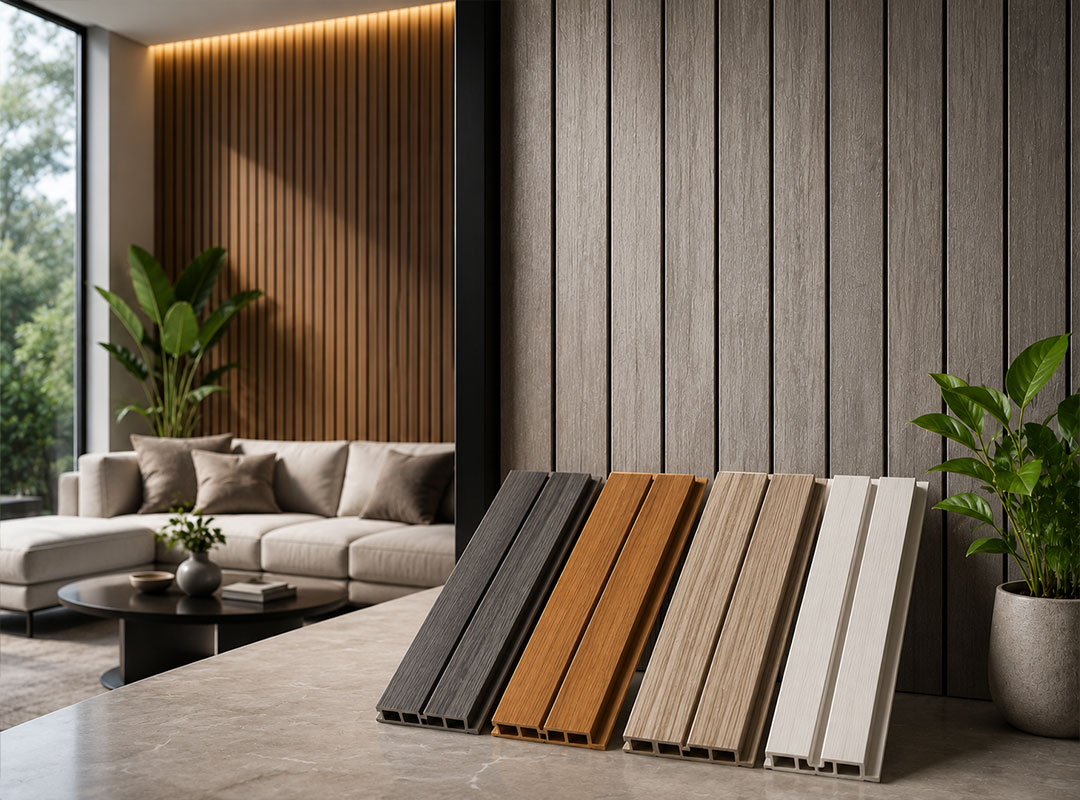
When learning how to choose WPC Wall Panels, thickness is often the first specification buyers compare. A 9 mm panel is commonly assumed to perform the same as another 9 mm panel, while a thicker panel is often perceived as stronger and more durable. In reality, WPC Wall Panel Thickness reveals very little about the actual quality or long-term performance of a product. Two panels with identical dimensions can differ significantly in structural strength, impact resistance, moisture stability, installation accuracy, and service life because their engineering extends far beyond external measurements.
Many purchasing decisions are still based primarily on thickness and price. However, experienced architects, contractors, and interior designers evaluate wall panels differently. They understand that a panel’s performance depends on raw material selection, density, manufacturing precision, internal construction, and quality control. Ignoring these factors may result in panels that initially appear identical but perform very differently after installation.
At Wonde®, manufacturing premium WPC Wall Panels involves much more than achieving a specific thickness. Every panel is engineered by carefully controlling material composition, extrusion technology, density, and production accuracy to deliver consistent WPC Wall Panel Quality across residential, commercial, hospitality, and retail applications. Understanding these engineering principles enables buyers to compare products based on performance instead of relying solely on thickness.
1. Thickness Is Only an External Measurement
One of the biggest misconceptions when choosing wall panels is assuming that thickness directly represents quality. In reality, thickness is simply a physical dimension that measures the distance between the front and back surfaces of a panel. It does not indicate how the panel is manufactured, what materials are used, or how it will perform over time. Two manufacturers may both produce a 9 mm WPC Wall Panel, yet one panel may have superior rigidity, impact resistance, and dimensional stability because of better engineering. Judging a panel only by its thickness is similar to judging a building only by the width of its walls without considering the quality of its concrete or steel reinforcement.
2. Raw Material Composition Determines Performance
The first step in understanding how to choose WPC Wall Panels is evaluating the materials used during manufacturing. WPC panels are produced by combining wood fibres with thermoplastic polymers, but the proportion, purity, and consistency of these materials vary significantly between manufacturers. Premium wood fibres improve structural consistency, while high-grade polymers enhance moisture resistance, dimensional stability, and long-term durability. Manufacturers also incorporate stabilisers, pigments, and performance additives that influence flexibility, thermal stability, and resistance to ageing. Inferior formulations containing inconsistent raw materials or excessive recycled contaminants often produce panels that weaken, discolour, or lose stability over time. This is why WPC Wall Panel Quality depends far more on engineered material composition than on thickness alone.
3. Density Has a Greater Impact Than Thickness
Among all manufacturing characteristics, density has one of the greatest influences on wall panel performance. Density refers to the amount of engineered material contained within the panel’s volume. Higher-density panels generally provide greater rigidity, stronger screw retention, improved impact resistance, and better long-term dimensional stability than lower-density alternatives of identical thickness. Lightweight panels may initially appear attractive because they are easier to handle, but insufficient density can reduce their structural integrity and increase the risk of deformation during installation or everyday use. Professional manufacturers carefully control density throughout the extrusion process to ensure every panel delivers consistent mechanical performance rather than simply meeting dimensional specifications.
4. The Internal Structure Is Equally Important
The engineering hidden inside a wall panel is just as important as the surface visible after installation. Many WPC Wall Panels incorporate multi-chamber internal profiles or ribbed internal structures to reduce weight while maintaining strength. However, the effectiveness of these structures depends entirely on their design. The number of chambers, rib thickness, spacing, and geometry determine how evenly loads are distributed throughout the panel. Poorly designed internal structures create stress concentrations that increase the likelihood of cracking, bending, or deformation over time. Well-engineered profiles maximise stiffness without increasing overall thickness, allowing two panels with identical dimensions to perform very differently under the same conditions.
5. Manufacturing Precision and Quality Control
High-quality raw materials alone cannot guarantee superior performance. During extrusion, manufacturers must precisely control temperature, pressure, cooling rates, calibration, and production speed to achieve consistent dimensions and density. Even small manufacturing variations can affect installation accuracy, structural stability, and long-term durability. Quality control therefore plays an equally important role. Every production batch should be inspected for dimensional accuracy, density consistency, surface finish, and profile stability before leaving the factory. Wonde® follows stringent manufacturing and quality assurance processes to ensure its WPC Wall Panels maintain reliable performance across different projects and production batches, providing architects, contractors, and homeowners with products they can install confidently.
6. Surface Technology Determines Everyday Durability
Although the internal structure provides strength, the outer surface determines how well a panel withstands everyday use. Furniture movement, accidental impacts, routine cleaning, and exposure to light gradually wear down inferior finishes. High-quality surface technologies improve scratch resistance, stain resistance, colour retention, and ease of maintenance without affecting WPC Wall Panel Thickness. Premium decorative layers and protective coatings also help preserve the appearance of the panel over many years, ensuring that interiors continue to look professional with minimal maintenance. This explains why two panels with identical dimensions may deliver completely different long-term performance depending on the quality of their surface engineering.
7. Thermal and Moisture Performance Depend on Engineering
A common misconception is that increasing WPC Wall Panel Thickness automatically improves thermal stability and moisture resistance. In reality, both characteristics are primarily determined by material formulation and manufacturing quality. Interior wall panels are constantly exposed to temperature changes caused by air conditioning, lighting, sunlight, and seasonal weather, causing materials to expand and contract over time. Well-engineered panels minimise these dimensional changes through balanced polymer composition and controlled extrusion. Similarly, moisture resistance depends on the quality of the polymer matrix and the uniformity of the internal structure rather than thickness alone. Poorly manufactured panels may absorb moisture through microscopic voids despite being thicker, whereas premium panels remain stable even in humid environments such as Singapore. This demonstrates why WPC Wall Panel Quality cannot be judged simply by external dimensions.
8. Installation Performance Reflects Product Quality
Installation is often the first stage where differences in manufacturing quality become visible. Panels with inconsistent dimensions, inaccurate edge profiles, or poor straightness require additional adjustments during installation, increasing labour time and material wastage. In contrast, precision-engineered panels fit together accurately, producing tighter joints, cleaner alignment, and a more professional finish. Reliable installation not only improves aesthetics but also reduces the likelihood of future issues such as uneven gaps or loose connections. When evaluating how to choose WPC Wall Panels, installation performance is therefore an important indicator of manufacturing precision rather than merely a convenience for installers.
9. Why Wonde® Focuses on Engineering Instead of Specifications
At Wonde®, product development is driven by engineering performance rather than simply meeting dimensional specifications. Every panel is designed by carefully balancing raw material composition, density, extrusion precision, profile geometry, and quality control to achieve consistent WPC Wall Panel Quality across every production batch. This engineering-first approach allows Wonde® to manufacture wall panels that deliver reliable structural performance, installation accuracy, and long-term durability while maintaining premium aesthetics. Instead of relying on thickness as a marketing specification, Wonde® focuses on creating products that consistently perform across residential, hospitality, commercial, and retail environments.
Understanding how to choose WPC Wall Panels requires looking beyond thickness and considering the engineering that determines long-term performance. While WPC Wall Panel Thickness is an important dimensional specification, it provides only a small part of the overall picture. Raw material composition, density, internal structure, manufacturing precision, surface technology, thermal stability, moisture resistance, and quality control collectively determine how a wall panel performs throughout its lifecycle.
For architects, builders, interior designers, and property owners, selecting wall panels based solely on thickness or price can lead to higher maintenance costs and inconsistent performance over time. Evaluating WPC Wall Panel Quality provides a far more accurate measure of durability, reliability, and long-term value. Wonde® follows this engineering philosophy across its product range, ensuring every panel delivers consistent quality, precision, and performance. By focusing on engineering instead of specifications alone, Wonde® enables customers to invest in wall panel solutions that continue to perform reliably long after installation.