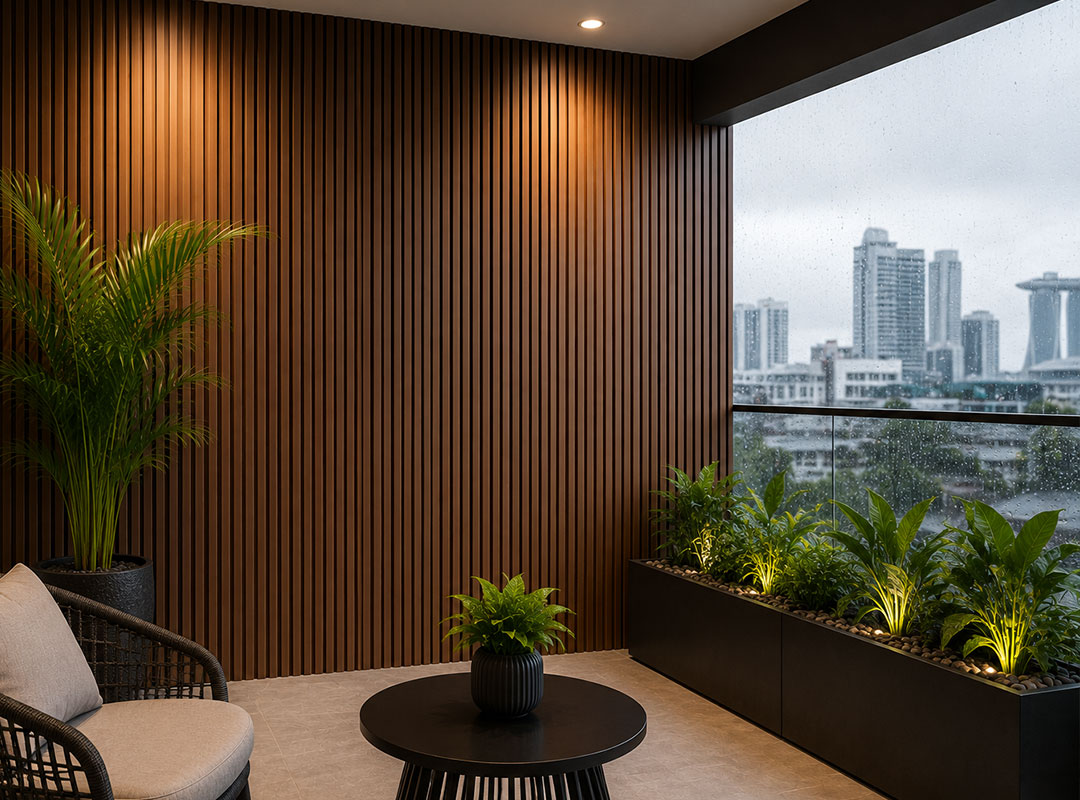
The materials installed on interior walls can contribute to the air people breathe. Emissions depend on product formulation, coatings, adhesives, quantity installed and ventilation. Wood-plastic composite (WPC) panels are engineered materials, so their emissions cannot be judged from the name alone. Similar-looking products may use different polymers, additives, printed layers or bonding systems. Wonde® offers panels in Stone, Wood Grain, Metallic, Cloth Pattern and Solid Colour finishes. The important question is what product-specific evidence says about the substances a panel may release into indoor air.
1. What Are VOCs, and Why Do They Matter Indoors?
Volatile organic compounds (VOCs) are carbon-containing chemicals that can evaporate into the air. Sources include paints, coatings, adhesives, cleaning products, furniture and some building materials. Their properties and health effects vary, so the term “VOC” does not describe one level of risk. Depending on the compound and exposure, effects may include eye, nose or throat irritation, headaches or more serious health effects. The US Environmental Protection Agency notes that VOC concentrations can be higher indoors than outdoors and may remain elevated after some products are used. Actual room concentration is not identical to a chamber result: it depends on the quantity of material, room volume, temperature, humidity and air exchange. For indoor air quality, a test report is most useful when its method and result are understood together, rather than compared with a rating from an unrelated protocol. When comparing low-VOC wall panels, look for measured emissions rather than an unexplained claim. A lower-emitting product reduces one potential source but cannot guarantee good indoor air quality, which also depends on other sources and ventilation.
2. Is an Odour a Reliable Sign of Emissions?
Smell is not a dependable way to measure chemical emissions. Some substances are detectable at low concentrations, while other pollutants have little or no noticeable odour. A strong smell also does not automatically prove that a material has reached a harmful concentration. Emissions from WPC wall panels can depend on formulation, surface layers, manufacturing residues and installation products. An odourless showroom sample is not proof of low emissions under every condition, and a noticeable smell is not a substitute for laboratory analysis. Request test evidence for the specific model. If a renovated room has a persistent chemical odour or causes irritation, increase ventilation, discuss possible sources with the contractor and seek qualified advice if the problem continues.
3. What Parts of a Panel Can Contribute to Emissions?
A wall panel is not necessarily a uniform material. Its core, pigments, stabilisers, surface film, printed design and protective coating may involve different ingredients. Emissions may originate from a coating or additive rather than the base polymer or fibre. WPC describes a family of composites, not a fixed recipe, so it is inaccurate to assume that every product emits the same chemicals or is automatically low-emitting. Wonde® offers different finishes, and the relevant document is the one for the exact product being specified. Ask whether the results apply to the complete finished panel and whether the tested formulation matches the current product. This prevents a test result for a raw material from being mistaken for evidence about the finished surface. This matters when comparing low-VOC wall panels: emissions data for an unfinished core may not describe the decorated panel delivered to a home. For this reason, assess WPC wall panels using product-specific data rather than assumptions based on the material category.
4. How Should Formaldehyde Be Considered Separately from VOCs?
Formaldehyde is one specific chemical that may be present in indoor air; it should not be treated as synonymous with all VOCs. It can be released by certain composite wood products, adhesives, coatings and other interior materials, although its presence and emission rate depend on the formulation. The Singapore National Environment Agency (NEA) states that, as of its April 2026 guidance, there are no regulatory requirements specifically addressing formaldehyde levels in most other building products, such as composite wood and adhesives, while voluntary guidance and product-labelling schemes are available. The NEA also introduced controls from 1 January 2026 restricting locally sold interior paints with formaldehyde content at or above 0.01% by weight. That paint rule should not be misrepresented as a blanket emissions limit for all wall panels. When assessing low-VOC wall panels, request evidence identifying whether formaldehyde was measured and what limit or classification the result meets. The NEA’s guidance on formaldehyde in interior building products explains the local position and available consumer options.
5. What Does a Useful Emissions Test Report Actually Show?
A useful report identifies the product, manufacturer, sample construction, test method, laboratory and result. Chamber testing measures substances released into a controlled volume of air over a specified period. The NEA identifies ISO 16000-9, ASTM D5116 and EN 16516 among commonly referenced chamber methods for formaldehyde testing. A report may measure one substance, total volatile organic compounds (TVOC), or both. TVOC is an aggregate measure; it does not identify every chemical or show whether each compound is below a health-based guideline. Results depend partly on sampling time, chamber conditions and material age. Before choosing low-VOC wall panels, check that the report covers the finished product rather than only a general material grade. Ask the supplier to clarify the method, testing scope and reported value. The NEA advises using accredited laboratories when reliable indoor formaldehyde measurements are required.
6. What Do Environmental Labels and Emission Grades Prove?
Environmental labels help comparison, but their scope matters. A certification may assess several environmental attributes, while a formaldehyde grade addresses a narrower issue. Neither should be assumed to cover every VOC or guarantee zero emissions. The Singapore Green Building Council’s Singapore Green Building Product (SGBP) scheme assesses products against published criteria. Consumers can also consult the Singapore Green Labelling Scheme directory. Wonde®’s WPC product information lists an “ENF” environmental protection grade; request the supporting report and confirm its scope, product identity and test method.
7. Can Adhesives and Other Installation Products Affect the Result?
Yes. Renovated-room air is influenced by the full set of materials, not just the visible panel. Adhesives, sealants, fillers, primers, paints and cleaning agents may release VOCs during and after application. A low-emitting panel can still be installed with a higher-emitting adhesive, so specify compatible products and request their emissions information. The US Environmental Protection Agency recommends choosing the least toxic, lowest-VOC adhesive or sealant suitable for the task and using only the amount required by the manufacturer. Do not substitute materials without checking compatibility. Include adhesives and finishing compounds when specifying low-VOC wall panels, follow product labels and maintain ventilation as directed.
8. How Can Homeowners Reduce Exposure After Installation?
Source selection and ventilation work together. Schedule products with potential emissions early enough to allow the room to air out before reoccupation. During and after installation, provide outdoor-air ventilation, using open windows and cross-ventilation where practical and safe. Follow instructions for curing time and room use; visible completion does not necessarily mean the room is ready for occupancy. NEA recommends maximising ventilation where formaldehyde sources are present and notes that the time needed for levels to fall varies. Fragrance sprays mask odours but do not remove the source. If indoor air quality remains a concern, consider testing by a laboratory accredited for the relevant measurements instead of relying solely on low-cost consumer sensors, whose accuracy can vary. If several products are installed at once, assess WPC wall panels as one part of the room’s overall material load. A test of the panel alone cannot measure the combined impact of cabinetry, flooring, paint, furnishings and cleaning products.
Choosing Wonde® Panels with Better Information
A well-informed purchase combines design preference with transparent evidence. Wonde® provides WPC panel options in several finishes, allowing homeowners to select an aesthetic that suits the interior without relying on appearance as a proxy for material safety. Ask for the documentation applicable to the exact panel, review any emission grade in context, and check the adhesives and finishing products specified for installation. If a seller uses terms such as “non-toxic,” “eco-friendly” or “zero VOC,” request a definition and supporting test data rather than treating the wording as a technical result.
For indoor air quality, a sensible approach is to reduce avoidable emission sources, use appropriately tested products and provide adequate ventilation before reoccupation. No single panel or label can guarantee the overall condition of a room’s air, because furnishings, paints, cleaning products and ventilation patterns all contribute. With clear product information and a considered installation plan, homeowners can make more informed decisions about WPC wall panels and create interiors that balance aesthetics with attention to material emissions and indoor health. The practical goal is to reduce avoidable emissions, not to assume that any single product makes a room pollutant-free.