Wall panels have become one of the most preferred interior solutions for homes, offices, retail spaces, hospitality projects, and commercial environments. Among the many materials available today, WPC wall panels have gained strong market demand because of their durability, modern aesthetics, moisture resistance, and relatively low maintenance requirements. However, despite their growing popularity, many buyers still make serious WPC Wall Panel Buying Mistakes that affect both the appearance and long-term performance of their interiors.
Choosing the wrong WPC wall panels can lead to premature wear, poor finishing quality, discoloration, installation failures, and higher maintenance costs over time. One of the biggest reasons these issues occur is because buyers often focus only on visual appeal while overlooking critical technical factors such as material composition, surface durability, installation compatibility, and environmental suitability. Understanding how to choose WPC Wall Panels properly is essential for ensuring long-term value and performance.
For residential homeowners, architects, interior designers, and commercial developers alike, selecting the right wall panel system requires more than comparing colors and textures. High-performance WPC wall panels are engineered products designed to deliver durability, dimensional stability, and design consistency over many years. Many of the Common Problems with WPC Wall Panels arise because buyers fail to evaluate quality standards before making a purchase decision. Here are the most common mistakes people make when choosing WPC wall panels and how to avoid them.
1. Ignoring the Quality of Raw Materials
One of the biggest mistakes buyers make is assuming that all WPC wall panels are manufactured using similar materials and production standards. In reality, the quality of wood fibers, polymers, additives, and stabilizers used during manufacturing directly affects the strength, durability, and lifespan of the panels. Low-grade raw materials often lead to cracking, warping, fading, and structural instability after prolonged usage. Premium manufacturers use balanced formulations and advanced extrusion technology to improve moisture resistance, dimensional stability, and impact strength. Ignoring raw material quality remains one of the most damaging WPC Wall Panel Buying Mistakes because inferior panels may deteriorate much faster than expected.
2. Choosing Panels Based Only on Appearance
Many buyers make purchasing decisions purely based on design samples, colors, or decorative textures without evaluating technical performance. While aesthetics are important, a visually attractive panel may not necessarily perform well under long-term usage conditions. Decorative wall panels installed in humid spaces, commercial environments, or high-traffic areas require stronger structural performance and surface durability. Understanding How to Choose WPC Wall Panels involves evaluating factors such as density, impact resistance, installation compatibility, and finish durability alongside visual appearance.
3. Not Checking Moisture Resistance Capabilities
WPC wall panels are widely promoted as moisture-resistant products, but not all panels provide the same level of protection. Lower-quality panels may absorb moisture over time due to weak core structures or poor sealing processes. This can eventually lead to swelling, fungal growth, delamination, or surface deformation. Moisture resistance becomes especially important in kitchens, bathrooms, basements, and tropical environments where humidity levels remain consistently high. Some premium composite wall panel systems are engineered with low water absorption rates and higher-density cores to improve long-term stability. Moisture-related failures remain one of the most overlooked Common Problems with WPC Wall Panels in poorly selected products.
4. Overlooking Fire Safety Standards
Fire safety is one of the most critical but frequently ignored factors when selecting wall panels. Many buyers focus entirely on aesthetics and pricing without checking whether the panels comply with fire safety standards or fire-retardant classifications. Inferior products may ignite more easily or release harmful smoke during fire exposure. This issue becomes even more important in hotels, offices, commercial projects, and public buildings where fire compliance standards are mandatory. High-quality WPC wall panel systems often undergo fire resistance testing to meet stricter commercial safety requirements. Ignoring these standards can create major safety and regulatory risks.
5. Selecting the Cheapest Option Available
Choosing the cheapest available product is one of the most common reasons buyers experience poor long-term results. Extremely low-cost WPC panels are often manufactured with lower-density materials, inconsistent finishing, poor UV protection, and weaker structural cores. Although the initial purchase cost may appear attractive, the long-term expenses associated with repairs, discolouration, maintenance, or replacement become significantly higher. Understanding how to choose WPC Wall Panels requires evaluating long-term durability and performance rather than focusing only on upfront pricing. High-quality decorative wall panel systems deliver better value because they maintain their appearance and structural stability for much longer periods.
6. Ignoring UV Resistance and Colour Stability
Many buyers underestimate the impact of sunlight and artificial lighting on WPC wall panels over time. Panels without proper UV-resistant coatings may gradually fade, discolor, or lose their original texture after prolonged exposure to sunlight. This issue becomes particularly noticeable in spaces with large windows, semi-outdoor installations, balconies, retail storefronts, or brightly lit interiors. High-performance WPC wall panels are often manufactured with anti-fading coatings and UV stabilizers to maintain color consistency and finish quality for extended periods. Ignoring UV protection can significantly reduce the visual lifespan of the installation.
7. Not Understanding the Installation Requirements
Different WPC wall panel systems require different installation methods, support structures, and spacing allowances. Many buyers purchase panels without fully understanding substrate compatibility, mounting systems, or installation conditions. Poor installation can result in uneven alignment, visible gaps, loose fittings, and long-term structural instability. Professional installation guidance is essential because even premium wall panels can fail when installed incorrectly. Improper installation practices remain one of the leading Common Problems with WPC Wall Panels in both residential and commercial projects.
8. Failing to Match Panels with the Application Area
Not all WPC wall panels are designed for the same applications. Some are intended primarily for decorative indoor use, while others are engineered specifically for moisture-prone, high-impact, or commercial environments. Buyers often choose panels based solely on design without considering where the product will actually be installed. Decorative-grade panels may not withstand heavy commercial usage or continuous humidity exposure. Matching the product specification with the intended application area is essential for avoiding expensive WPC Wall Panel Buying Mistakes and ensuring long-term durability.
9. Ignoring Surface Finish Durability
The surface finish of a WPC wall panel directly affects both appearance and maintenance performance. Some low-quality products use weak lamination methods or low-grade surface coatings that peel, scratch, or wear out quickly. In high-contact areas, poor finishes may begin deteriorating within a short period after installation. Premium WPC wall panels typically feature stronger protective layers designed to improve scratch resistance, stain resistance, and long-term finish consistency. Durable finishes also simplify cleaning and maintenance while preserving the original appearance of the panels.
10. Not Asking About Maintenance Requirements
Many people assume that all WPC wall panels are entirely maintenance-free. While WPC products generally require less upkeep than natural wood or traditional wall materials, maintenance expectations still vary depending on panel quality and surface finishing technology. Some surfaces attract dust more easily, while others may require specific cleaning methods to preserve the finish quality. Failing to understand long-term maintenance requirements can eventually create dissatisfaction and additional upkeep expenses. Several long-term Common Problems with WPC Wall Panels occur because buyers are unaware of proper maintenance practices.
11. Overlooking Environmental and Sustainability Standards
Sustainability has become increasingly important in modern interior and architectural projects, yet many buyers still ignore environmental manufacturing standards when selecting wall panels. Not all WPC products are manufactured using environmentally responsible processes. Low-quality manufacturers may use harmful additives, poor recycling practices, or substandard production methods that negatively affect indoor air quality and sustainability performance. Reputable manufacturers often use safer material formulations and more responsible production technologies to support sustainable building practices and healthier indoor environments.
12. Choosing the Wrong Panel Thickness
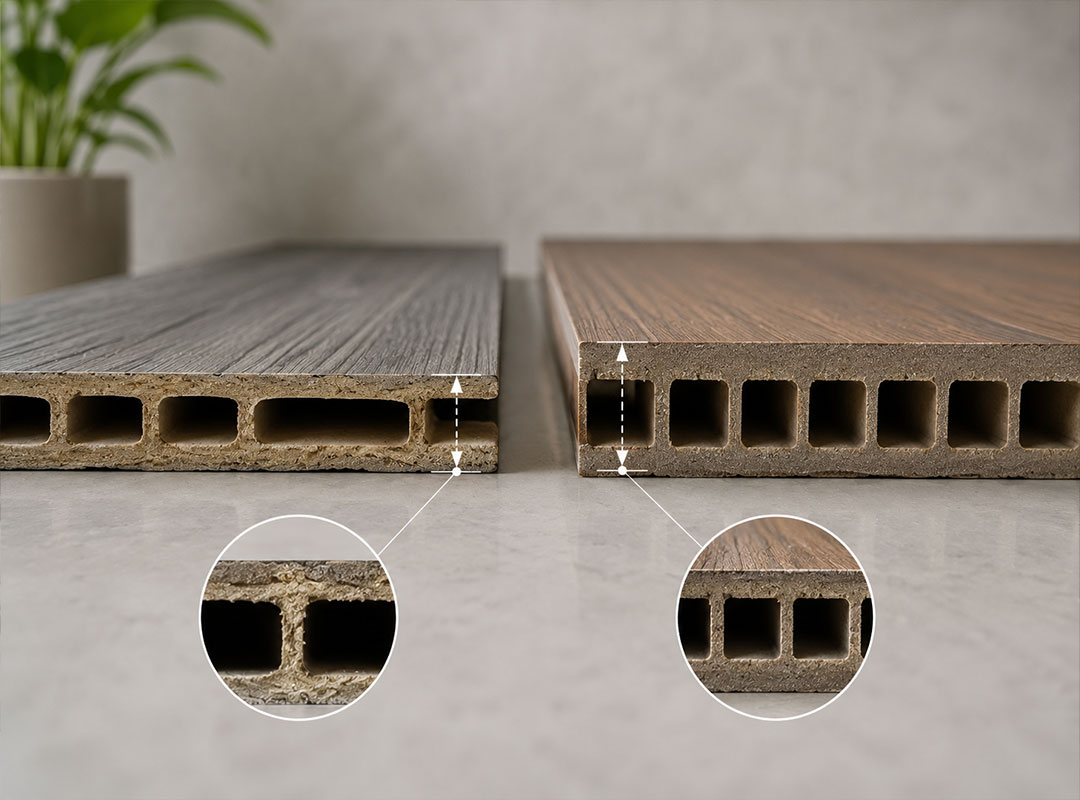
Panel thickness plays a significant role in structural rigidity, impact resistance, and acoustic performance. Buyers sometimes choose thinner panels simply to reduce project costs without considering long-term durability requirements. Thin panels may flex more easily, dent under pressure, or perform poorly in larger wall applications. Commercial wall panel systems typically require stronger structural performance due to higher usage demands. Understanding how to choose WPC Wall Panels includes selecting the appropriate panel thickness based on installation environment, wall dimensions, and functional requirements.
13. Ignoring Acoustic Performance
Acoustic performance is becoming increasingly important in offices, conference rooms, hospitality spaces, entertainment areas, and premium residential interiors. However, many buyers fail to evaluate the sound absorption or sound insulation properties of WPC wall panels. Some advanced panel systems are specifically engineered to improve acoustic comfort by reducing echo and enhancing indoor sound quality. Ignoring acoustic performance may result in spaces that appear visually attractive but lack overall comfort and functionality.
14. Not Verifying Product Certifications
Product certifications provide important assurance regarding safety, quality, and technical performance standards. However, many buyers fail to verify whether their selected WPC wall panels comply with recognized testing requirements for fire resistance, moisture performance, VOC emissions, or structural durability. Reputable manufacturers invest in stricter quality control systems and certified testing procedures to validate product reliability. Failing to verify certifications is one of the most preventable WPC Wall Panel Buying Mistakes made by uninformed buyers.
15. Focusing Only on Trends Instead of Long-Term Design
Interior design trends evolve rapidly, but wall panel installations are generally intended to remain in place for many years. Buyers who select highly trend-driven colours or textures may eventually find their interiors looking outdated much sooner than expected. Neutral finishes, balanced textures, and timeless designs generally offer stronger long-term visual value. High-quality decorative wall panel systems should complement evolving interior styles rather than require frequent replacement due to changing trends.
16. Ignoring the Reputation of the Manufacturer
The reputation and manufacturing expertise of a supplier significantly influence product consistency, finish quality, and long-term reliability. Buyers sometimes purchase WPC wall panels from unknown suppliers offering aggressive discounts without evaluating quality standards, warranty support, or technical expertise. Established manufacturers typically invest more heavily in advanced production technologies, testing procedures, and technical support systems. Choosing trusted suppliers is a critical part of understanding how to choose WPC Wall Panels professionally and avoiding future performance issues.
17. Not Considering Expansion and Contraction
Like many composite materials, WPC wall panels may experience slight expansion and contraction due to temperature fluctuations. Installers who fail to account for these natural movements during installation may eventually encounter buckling, pressure damage, or visible gaps between panels. Proper installation spacing and expansion allowances are necessary to maintain dimensional stability over time. Ignoring these technical requirements can lead to serious long-term Common Problems with WPC Wall Panels in changing environmental conditions.
18. Underestimating the Importance of Proper Lighting
Lighting conditions significantly affect how WPC wall panels appear after installation. Colours, textures, grains, and finish details may look very different under natural sunlight, warm lighting, or cool artificial lighting environments. Buyers often select panels under showroom lighting conditions without reviewing how the materials will appear in the actual project space. Evaluating panel samples under realistic lighting conditions helps prevent design mismatches and unnecessary WPC Wall Panel Buying Mistakes.
19. Neglecting Warranty Details
Warranty coverage is another factor many buyers fail to evaluate carefully before purchasing WPC wall panels. Some products offer limited warranties that exclude fading, moisture-related damage, or installation issues. Others provide minimal coverage periods that do not reflect confidence in long-term product performance. Understanding warranty limitations provides valuable insight into the reliability of both the product and the manufacturer. Strong warranty support often reflects stronger manufacturing standards and quality assurance processes.
20. Assuming All WPC Panels Are Identical
Perhaps the biggest misconception in the market is the assumption that all WPC wall panels deliver similar quality and performance. In reality, there are major differences in engineering quality, raw material composition, extrusion technology, finishing systems, and testing standards across manufacturers. Buyers who treat WPC wall panels as generic products often make decisions based only on price or appearance. Proper research into how to choose WPC Wall Panels can help buyers avoid poor-quality products and expensive long-term issues.
WPC wall panels have transformed modern interiors by offering a combination of aesthetics, durability, moisture resistance, and low maintenance. However, achieving the best results depends heavily on selecting the right products for the intended application. Many buyers make avoidable mistakes because they focus too heavily on price or visual appeal while ignoring technical specifications, installation requirements, safety standards, and long-term durability factors. These oversights often lead to serious Common Problems with WPC Wall Panels that could have been avoided through better product evaluation.
Choosing high-quality WPC wall panels is not only about enhancing visual appeal. It is about ensuring long-term structural performance, safety, finish durability, and overall value. Avoiding major WPC Wall Panel Buying Mistakes helps homeowners, architects, designers, and developers achieve stronger project outcomes with fewer maintenance concerns and better long-term satisfaction.
For any residential or commercial project, selecting a trusted WPC wall panel manufacturer with proven quality standards, advanced manufacturing capabilities, and reliable technical support is essential. Understanding how to choose WPC Wall Panels carefully ensures better durability, stronger aesthetics, and long-term performance consistency for modern interior spaces.