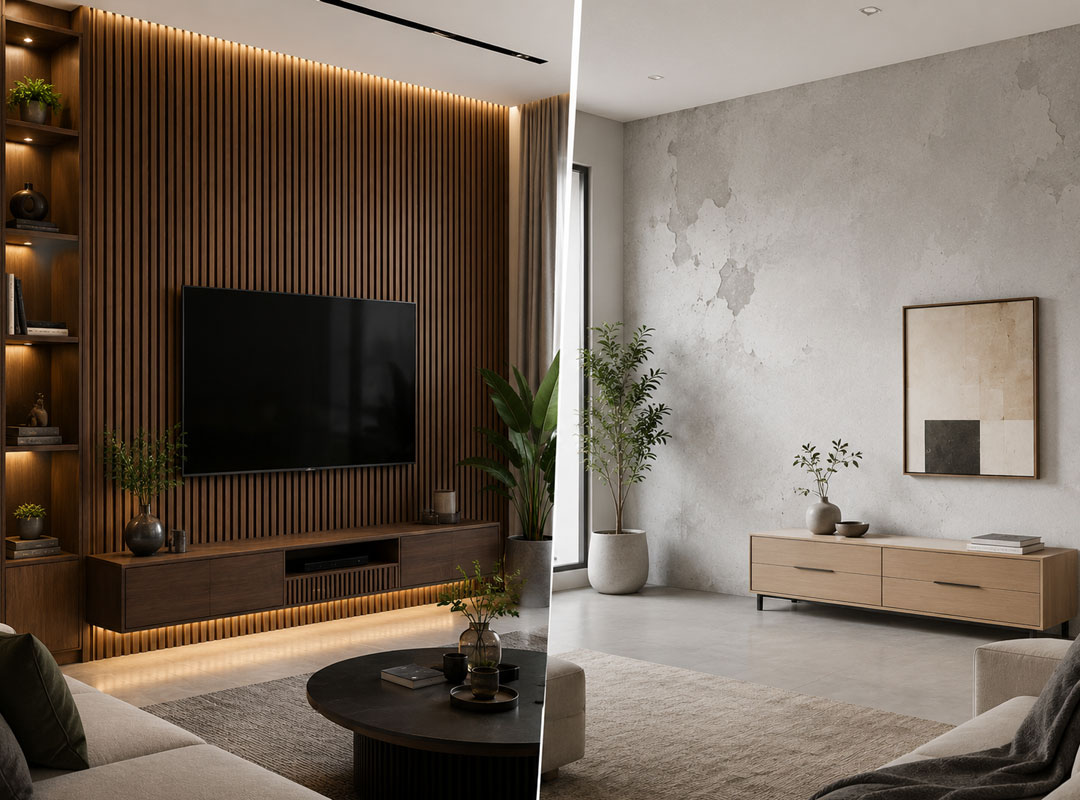
Walls were once treated as background surfaces within interior architecture. Their role was largely utilitarian, limited to enclosure, partitioning, and surface finishing. Contemporary interior design has fundamentally changed that approach. Today, walls are integrated into the architectural language of a space, contributing directly to spatial identity, acoustic quality, lighting interaction, material continuity, and user experience.
The evolution from flat painted walls to engineered feature wall systems reflects broader changes across architecture and interior design. Urban density, open-plan layouts, hospitality-driven residential aesthetics, commercial branding requirements, and advancements in material engineering have collectively transformed wall treatments into performance-oriented design elements. This shift has accelerated the adoption of Modern Feature Wall Design across both residential and commercial sectors.
Feature walls are no longer decorative additions applied at the end of a project. They are increasingly specified during the conceptual design phase because they influence spatial hierarchy, circulation, acoustics, maintenance requirements, and overall design cohesion. Modern wall systems are expected to deliver visual depth while simultaneously addressing practical concerns such as durability, installation efficiency, sustainability, and acoustic control through advanced Interior Wall Panel Solutions.
The growing adoption of Contemporary Wall Panel Systems across residential, commercial, retail, hospitality, and corporate environments demonstrates how vertical surfaces have become critical components of contemporary interiors rather than passive backgrounds.
1. The Architectural Shift from Surface Treatment to Spatial Definition
Traditional interior construction prioritized floors and furniture as primary visual anchors, while walls were treated as neutral surfaces finished with paint, veneer, or wallpaper. This design approach became increasingly insufficient as interiors shifted toward open spatial planning and minimalist aesthetics.
Open-plan environments reduced the number of physical partitions within interiors, increasing the visual responsibility of remaining wall surfaces. Feature walls emerged as architectural devices capable of defining zones, directing visual attention, and establishing hierarchy without interrupting spatial continuity. As a result, Modern Feature Wall Design has become an important tool in spatial planning and interior zoning.
In contemporary interiors, wall articulation is often used to organize movement and create focal alignment. Vertical slat systems, recessed panel compositions, textured surfaces, and integrated lighting details are now deployed to influence perception and scale. Rather than occupying space physically, feature walls define space visually.
This architectural role is particularly significant in compact urban interiors where maximizing openness while maintaining spatial distinction is a key design challenge.
2. Material Innovation Has Redefined Interior Wall Systems
The development of engineered interior materials has significantly expanded the functional and aesthetic capabilities of wall applications. Conventional painted drywall surfaces offer limited dimensionality, low impact resistance, and frequent maintenance requirements. Modern wall systems address these limitations through material engineering and precision manufacturing.
Contemporary feature wall systems commonly incorporate high-pressure laminates, engineered wood composites, PET acoustic substrates, fluted profiles, aluminum detailing, and moisture-resistant core materials. These materials are selected not only for appearance but also for structural stability, durability, acoustic performance, and installation consistency. These advancements have elevated the market for Interior Wall Panel Solutions that combine technical reliability with architectural sophistication.
Precision-manufactured panels have also improved finish uniformity across large-scale applications. Unlike traditional on-site finishing methods, modular wall systems reduce inconsistencies caused by labor variability, substrate imperfections, and environmental conditions during construction.
This transition toward engineered systems reflects the broader industrialization of interior construction, where predictability, efficiency, and long-term performance are becoming increasingly important across both residential and commercial projects.
3. Feature Walls Have Become Central to Hospitality-Led Residential Design
Residential interiors have undergone a major aesthetic shift influenced heavily by hospitality environments. Homeowners increasingly expect residential spaces to deliver the same level of visual sophistication, material layering, and experiential quality found in luxury hotels, premium retail spaces, and branded commercial environments.
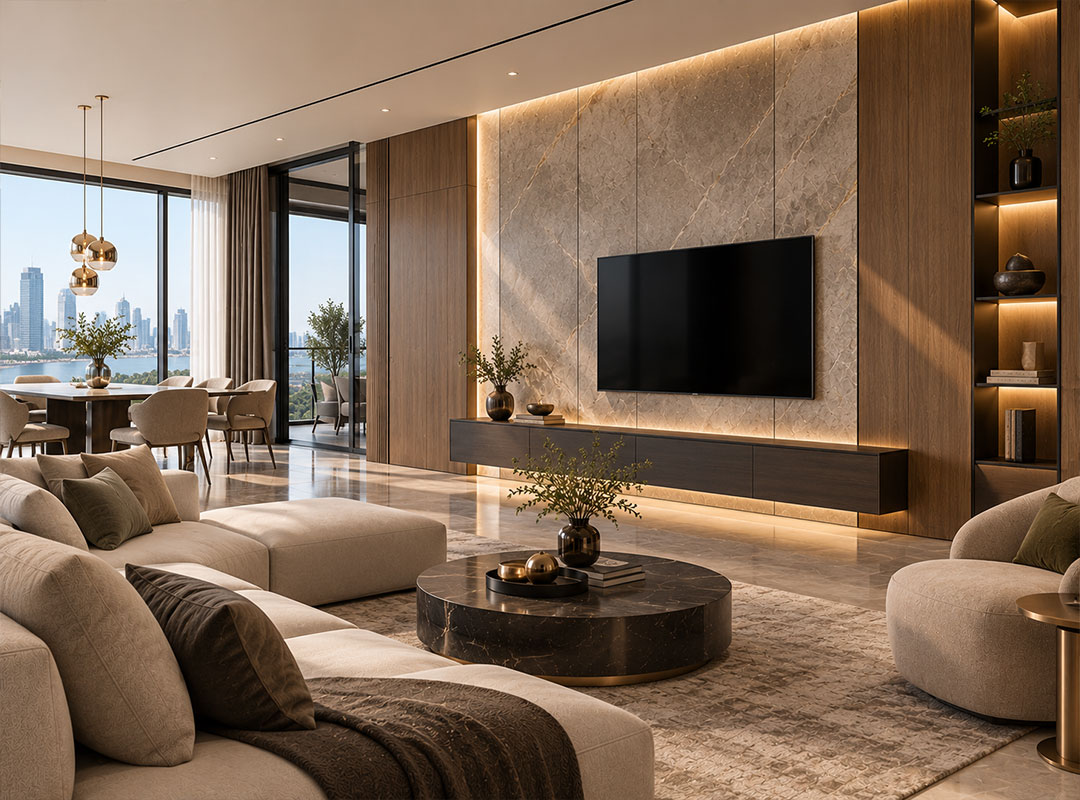
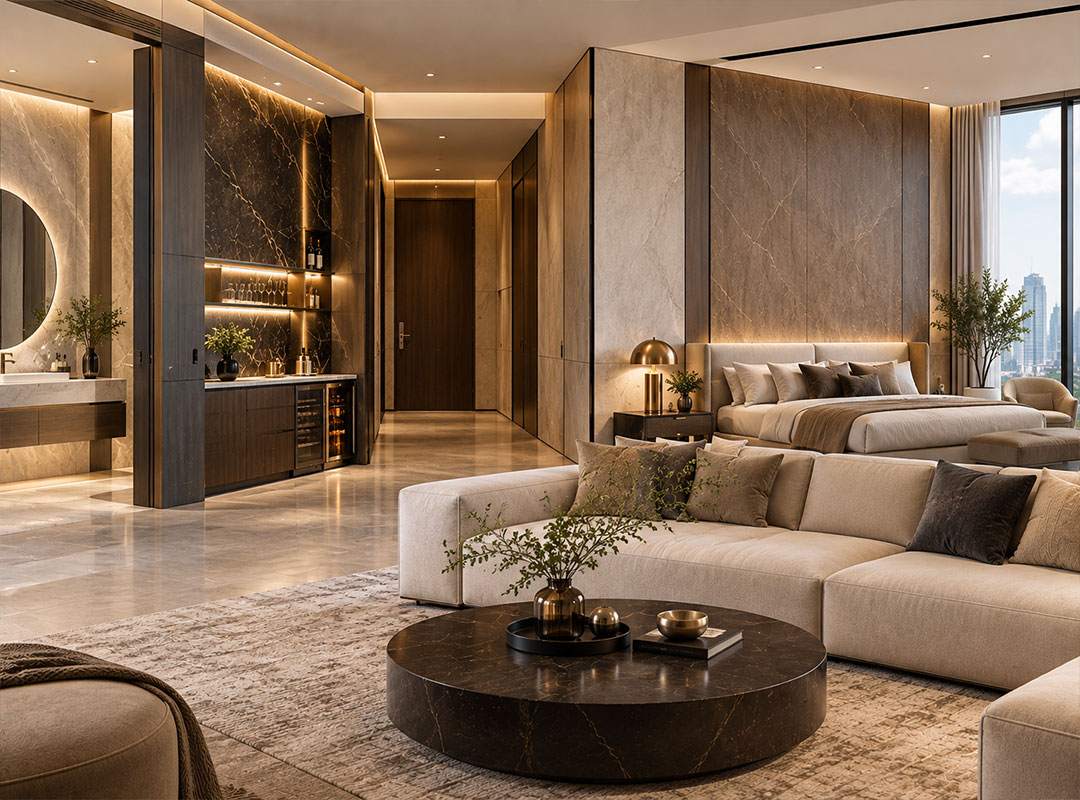
Feature walls have become central to achieving this transition. In living areas, integrated wall systems now combine entertainment units, concealed storage, shelving, lighting, and material transitions into unified architectural compositions. Bedroom feature walls increasingly incorporate upholstered textures, vertical slat detailing, and ambient lighting integration to create spatial depth and visual softness. Contemporary Wall Panel Systems are now widely used in premium residential developments to create this hospitality-inspired aesthetic.
This evolution is particularly visible in contemporary condominium and apartment developments where developers use feature wall systems to increase perceived design value without altering structural layouts. Carefully executed wall treatments can significantly elevate spatial perception, making compact interiors appear more refined and architecturally complete.
The emphasis has shifted from decorative ornamentation toward controlled material expression and clean architectural detailing associated with Modern Feature Wall Design.
4. Commercial Interiors Use Feature Walls as Brand Infrastructure
Commercial design has moved beyond purely functional space planning. Interior environments are now expected to communicate brand positioning, operational culture, and customer experience objectives. Feature walls play a major role in this architectural branding strategy.
In corporate environments, reception walls are increasingly designed as integrated identity surfaces incorporating acoustic treatment, lighting systems, signage, and material contrast. These installations establish immediate visual recognition while reinforcing perceptions of professionalism and design quality. Many businesses now invest in Interior Wall Panel Solutions to create stronger visual consistency across office environments.
Retail environments use wall systems to guide customer engagement and product focus. Textured backdrops, illuminated display panels, and layered material finishes help create visual sequencing throughout stores. In hospitality projects, feature walls contribute directly to atmosphere creation, influencing how guests perceive comfort, exclusivity, and spatial identity.
The commercial adoption of Contemporary Wall Panel Systems is not driven purely by aesthetics. Durable panel systems reduce operational maintenance, improve finish longevity, and provide scalable design consistency across multiple locations.
5. Texture Has Become a Critical Component of Modern Spatial Design
Contemporary interiors increasingly rely on texture to create visual complexity without excessive ornamentation. Minimalist design principles reduced the use of decorative clutter, forcing architectural surfaces themselves to carry more visual weight.
Textured wall systems address this requirement by introducing shadow depth, surface variation, and tactile contrast. Fluted panels, ribbed geometries, matte finishes, timber grains, and dimensional profiles create dynamic interactions with natural and artificial lighting conditions throughout the day. These qualities are central to successful Modern Feature Wall Design in contemporary interiors.
This interaction between texture and light is now a major consideration in interior specification. Flat painted walls reflect light uniformly, often producing visually static environments. Textured surfaces generate controlled shadow variation that changes according to viewing angle and lighting intensity, creating a more responsive and layered spatial experience.
As modern interiors continue favoring restrained color palettes, texture has become one of the primary methods for achieving sophistication without visual excess.
6. Acoustic Performance Is Driving Wall System Demand
The increasing adoption of open-plan architecture has amplified acoustic challenges across residential and commercial interiors. Hard flooring surfaces, exposed ceilings, glass partitions, and large uninterrupted volumes contribute to excessive reverberation and sound reflection.
This has accelerated demand for acoustic wall systems that combine sound absorption with architectural aesthetics. Acoustic slat panels have become particularly prominent because they integrate noise reduction capabilities within visually refined linear compositions. These applications are further strengthening demand for high-performance Interior Wall Panel Solutions.
In workplaces, acoustic wall treatments improve speech clarity, reduce distraction, and enhance user comfort. In hospitality environments, controlled acoustics directly influence guest experience by minimizing ambient noise levels. Residential applications increasingly incorporate acoustic panels within entertainment areas, home offices, and living spaces where sound management is becoming more important due to hybrid work environments.
The integration of acoustic functionality into decorative wall systems reflects the broader evolution of interiors toward performance-based design solutions rather than purely aesthetic installations.
7. Installation Efficiency and Modular Construction Are Reshaping Interior Specifications
Construction timelines, labor constraints, and quality control requirements have increased demand for prefabricated and modular interior systems. Traditional wall finishing methods often involve multiple site processes including plastering, sanding, painting, and finishing corrections, all of which increase labor dependency and project variability.
Engineered wall panel systems streamline installation through modular assembly and factory-controlled production. Precision manufacturing reduces alignment inconsistencies while minimizing on-site finishing requirements. This improves construction efficiency and significantly reduces installation timelines for large-scale projects. Contemporary Wall Panel Systems are particularly valued for their ability to support faster project execution without compromising finish quality.
Modular wall systems also simplify future maintenance and replacement processes. Individual panels can often be removed or replaced without disrupting surrounding surfaces, improving long-term operational flexibility.
As construction industries continue prioritizing efficiency and scalability, modular wall systems are becoming increasingly aligned with contemporary project delivery models and Modern Feature Wall Design strategies.
8. Sustainability Is Influencing Material Selection and Lifecycle Design
Sustainability considerations are now influencing interior material specifications at both consumer and institutional levels. Clients increasingly evaluate wall systems not only for appearance but also for lifecycle durability, maintenance frequency, environmental impact, and material sourcing.
Engineered wall systems often outperform conventional painted finishes in lifecycle performance because they require less frequent refinishing and generate lower long-term maintenance waste. Many contemporary wall panels also incorporate recyclable substrates, low-emission manufacturing processes, and responsibly sourced raw materials. This has increased the relevance of sustainable Interior Wall Panel Solutions within modern construction projects.
Durability has become a particularly important sustainability metric. Surfaces that resist scratches, moisture exposure, fading, and impact damage contribute to longer material lifespans and reduced replacement cycles.
The growing emphasis on lifecycle efficiency is shifting interior specification practices away from short-term cosmetic solutions toward durable architectural systems designed for long-term operational performance.
9. Lighting Integration Has Elevated the Importance of Wall Design
Modern lighting strategies increasingly treat walls as active reflective and compositional surfaces rather than passive boundaries. Feature walls are now frequently integrated with concealed lighting systems, recessed linear illumination, and shadow detailing to create layered visual effects.
This integration enhances spatial depth while emphasizing texture, geometry, and material transitions. Vertical slat systems, for example, produce highly controlled shadow gradients when illuminated from concealed light sources, creating architectural dimension that changes according to lighting conditions. This integration is now a defining characteristic of premium Modern Feature Wall Design.
Lighting integration has also increased the technical precision required in wall system installation. Alignment tolerances, joint detailing, and material consistency become more critical when surfaces are illuminated directly.
As lighting design continues evolving toward indirect and atmospheric applications, Contemporary Wall Panel Systems will remain central to achieving controlled visual environments.
10. Feature Walls Represent the Convergence of Architecture, Engineering, and Interior Design
The evolution of feature walls reflects a larger convergence occurring across architecture and interior design disciplines. Modern interiors increasingly require integrated systems that combine visual refinement with technical performance.
Feature wall systems now operate simultaneously as aesthetic elements, acoustic solutions, branding tools, lighting surfaces, and spatial organizers. Their growing importance is directly linked to rising expectations surrounding interior functionality, construction efficiency, and experiential quality. Advanced Interior Wall Panel Solutions are therefore becoming essential components in contemporary architectural specifications.
This evolution also signals a shift in how value is perceived within interior environments. Design quality is no longer determined solely by furniture selection or decorative styling. Increasingly, value is embedded within architectural detailing, material precision, and integrated surface systems that shape the overall spatial experience.
As contemporary interiors continue prioritizing durability, sensory engagement, and performance integration, feature walls will remain one of the defining components of modern architectural design. The transition from flat walls to engineered feature wall systems is not a temporary trend. It is a structural evolution in how interiors are conceived, constructed, and experienced through Contemporary Wall Panel Systems.
As feature walls continue evolving from decorative surfaces into integrated architectural systems, the importance of material quality, precision engineering, and functional performance becomes increasingly critical. Modern interiors now demand solutions that combine aesthetics, durability, acoustic efficiency, and installation flexibility within a single design framework.
Wonde® addresses these evolving requirements through advanced wall panel solutions designed for contemporary residential, commercial, hospitality, and corporate environments. With a focus on material innovation, refined finishes, and engineered performance, Wonde® delivers wall systems that enhance spatial depth, visual sophistication, and long-term usability.
From acoustic slat panels and textured surfaces to modern feature wall applications and modular panel systems, Wonde® supports architects, designers, developers, and homeowners in creating interiors that are both visually impactful and functionally efficient. As contemporary interiors continue prioritizing performance-driven design, engineered wall systems from Wonde® represent the next generation of architectural surface solutions.